Random Walk

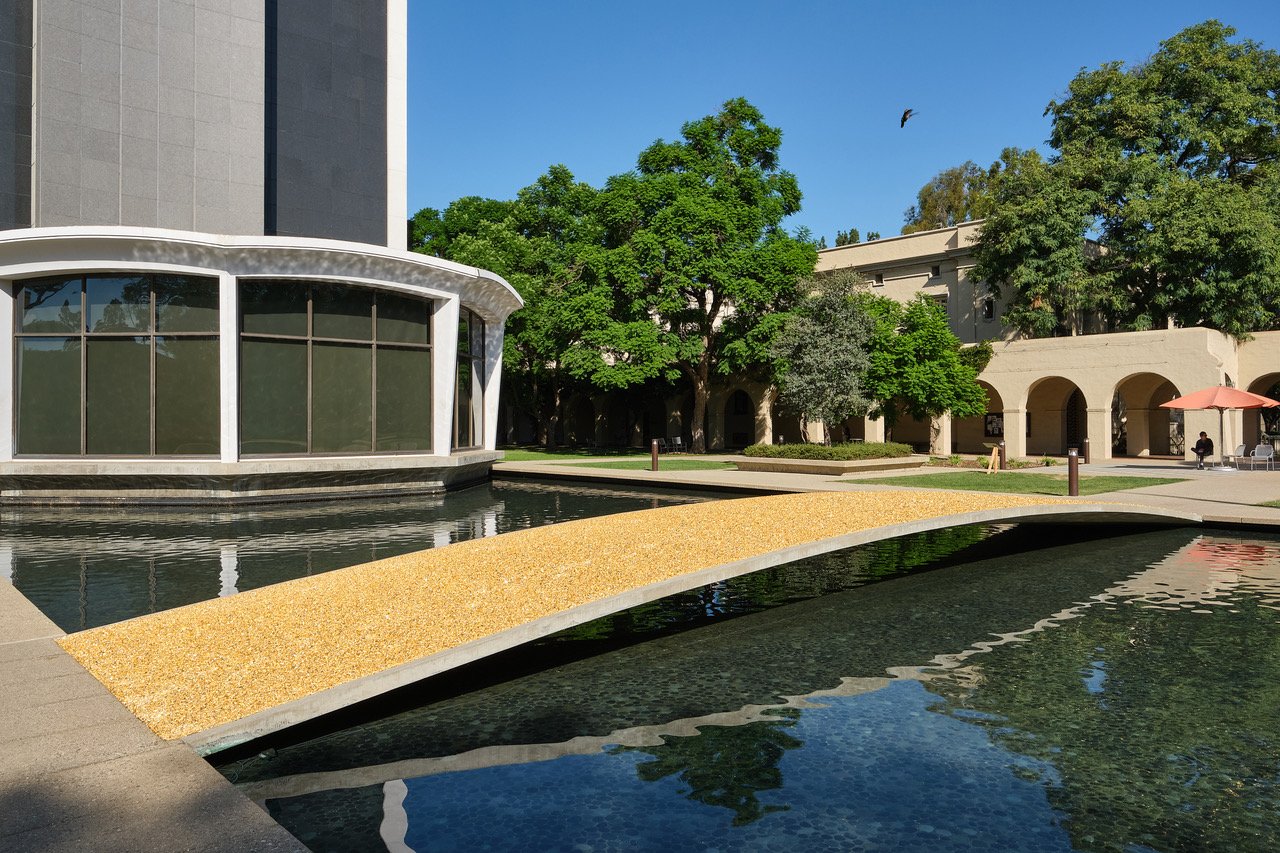
The Annenberg Center fronts on the Moore Walk, opposite Avery House.
Annenberg Center Dedicated
On October 30, 2009, Caltech’s newest building officially opened its doors. The Walter and Leonore Annenberg Center for Information Science and Technology (IST) will house members of the IST initiative, now scattered across campus. As Engineering and Applied Science Division Chair Ares Rosakis remarked at the dedication, “Many universities have created schools of information science. These programs generally focus on hardware and software. IST, in contrast, is based on the concept of information as a unifying principle. We have gathered people from computer science, physics, biology and bioengineering, economics, applied mathematics, computation and neural systems, applied physics, control and dynamical systems, and electrical engineering to think together about the fundamental theoretical underpinnings of information as well as its practical applications, such as computing with DNA, creating tunable biological circuits, understanding complex social systems, and designing a ‘smart’ electric grid.”
“IST is about connecting different areas of scientific and engineering inquiry,” says Peter Schröder, professor of computer science and applied and computational mathematics, and chair of the building committee. “We wanted to create a structure where you have a lot of transparency. People see each other; people get inspired by noticing something. You don’t want people to just disappear behind closed doors.” As a result, windows proliferate inside as well as outside. This ubiquity of glass allows sunlight to shine in from a spacious, two-story central atrium, flooding every office with the light that’s often rare in other structures—no grad students toiling in dungeon-like basements here. Fresh air also flows into the building through operable windows in nearly every office.
Natural light and air make Annenberg a comfortable place for contemplation—one of the guiding principles behind the center’s architecture, says Schröder. “A building is not going to generate an idea. It’s the people in the building that generate the ideas. But if the people are happy and they have pleasant encounters with their fellow occupants, then that’s going to support cross-fertilization between disciplines.”

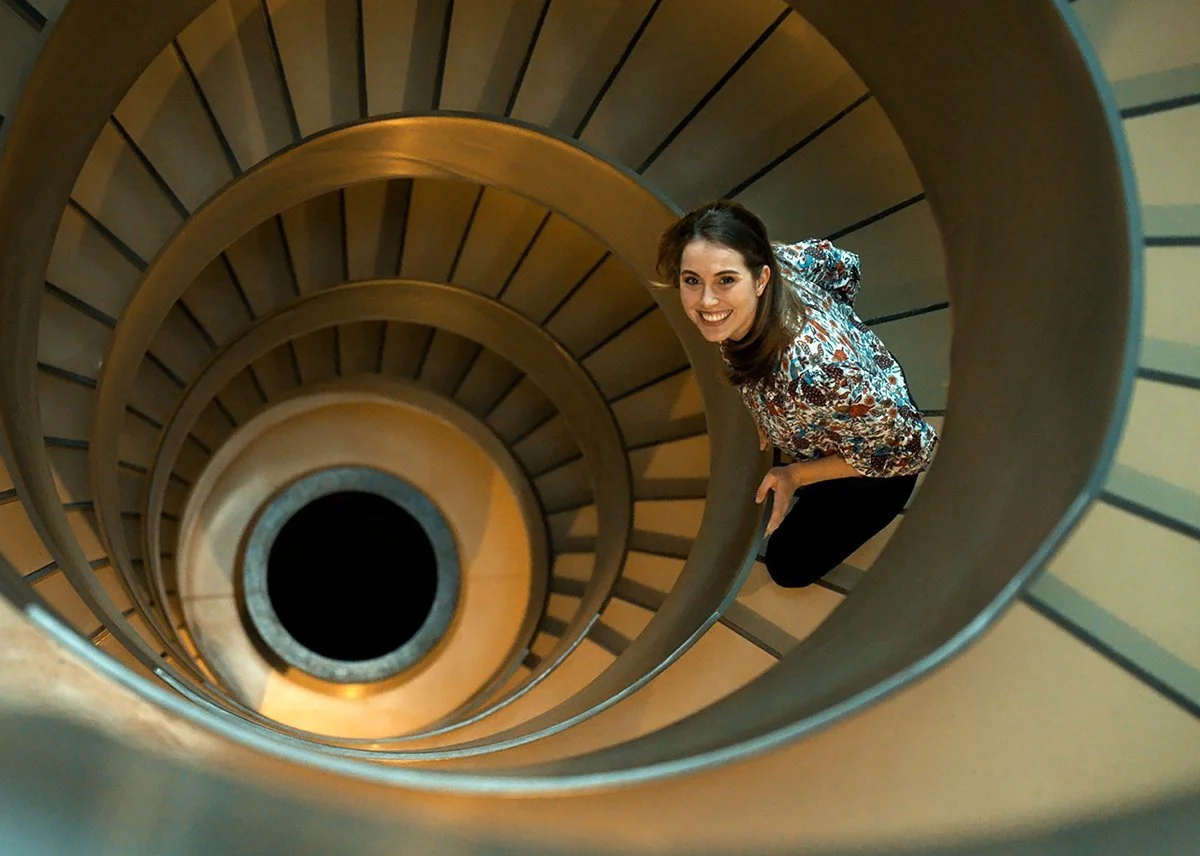
Windows on three sides let sunlight play over the lounge that projects from the northeast corner of the new Annenberg Center for Information Science and Technology. The indoor picnic table in front of the spiral staircase is a popular lunch spot.
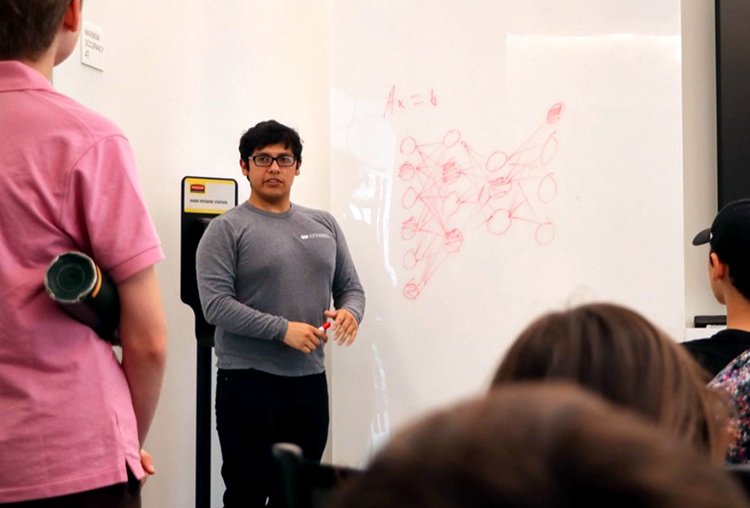
Office doors are slightly recessed, leading to jagged hallways that avoid the institutional, sterile feel of seemingly infinite corridors. Along the hallways and in corners, chairs and small tables beside whiteboards stocked with markers encourage impromptu discussions and, one hopes, fresh ideas. “These sorts of things are architectural theory until you see them actually used,” Schröder says, but one day he did see some grad students arguing over equations on the board. “That was one of those little moments where I felt pretty good about what we had done, that we had at least accomplished some of these lofty goals.” Tables and chairs scattered on the terrace on the north side of the building invite people to sit and linger, and there’s even an outdoor blackboard at the building’s southwest corner for scientific debates.

The lounge’s second floor has a whiteboard within arm’s reach of the comfy chairs. There’s also a rocking chair to stimulate deep thoughts—or a brain-refreshing doze.
Well-designed spaces don’t cost much more, Schröder says, and it’s worth it to improve the general well-being of the building’s inhabitants. For example, the designers chose furniture to be warm and relaxing, which goes a long way toward making people comfortable. Even the wall clocks, with their colors and astral shapes, are from a classic design by George Nelson, a founder of the American Modernism school. And the rich wood paneling found throughout the building is not only pleasing to the eye, but is actually bamboo—a sustainable material.
The building, designed by Frederick Fisher and Partners, is among several Caltech construction projects on track for gold certification under the Leadership in Energy and Environmental Design (LEED) rating system. The center’s building materials have at least 20 percent local—minimizing transportation and labor costs—or recycled content. The building also uses 25 percent less energy and 30 percent less water than California state law requires. The designers also minimized the use of harmful chemicals called volatile organic compounds, a feature chiefly noticeable by the lack of those new-paint and new-carpet smells.
Annenberg’s operable windows are another design triumph. Central heating and cooling systems don’t work well with open windows, but fresh air was seen as so important that independent climate controls were built into each room. This would have been significantly more expensive, were it not for an energy-efficient heating and cooling system that circulates hot and chilled water above the ceiling panels to adjust the temperature. This system is new to Caltech, although common in Europe, Schröder says. And because it doesn’t require big aluminum air ducts snaking overhead, the spaces between stories are smaller, which saves even more money—both in construction and operating costs.
Aesthetically, the building echoes the architectural rhythms of the campus, notes Schröder. The outdoor stairways reflect the styles of Spanish architecture (as an added bonus, they save more money by not needing walls and a roof around them), as do the repeating window patterns. The green exterior mimics the hues of olive leaves on the trees that dot the campus.

Floor-to-ceiling windows opening into the atrium let light into the research groups’ studios. The “trellis” of jigsawed bamboo was generated by a random-line algorithm as a representation of a densely connected network.

Hidden therein is a Caltech beaver.
The center houses 16 research units. There are no wet labs; instead, each unit has a common room called a “studio.” But there’s a lab full of workstations for undergrads to use on class projects, and a machine room packed with high-powered cluster computers that serve the entire campus.
The building’s culture is decidedly egalitarian: all the offices are roughly the same size (although grad students and postdocs still have to share space with each other), and the best areas are shared by all: the northeast lounge, for example, boasts sweeping views of the San Gabriel Mountains. “The idea was that the best, most beautiful piece of real estate should be made public,” Schröder says.
Good design is more than just good looks, Schröder argues. It makes a “difference in the quality of our lives, in the mood of our spirits, and in the loftiness of our creative flights.” How high these creative flights go remains to be seen. “We’ll have to give it a year or two before we can truly evaluate how various things are working out,” he says. “But so far, so good.”
Built by Hathaway Dinwiddie, the $31 million building was made possible by the Annenberg Foundation and by Stephen Bechtel Jr. The Moore Foundation provided the seed funding for the IST initiative. —MW
The Annenberg Center dedication video is available online, as is an interview with Jehoshua “Shuki” Bruck, founding director of the IST program and the 2008 winner of Caltech’s Feynman Prize for Excellence in Teaching. You can also view a slideshow of interior and exterior pictures of the Annenberg Center.